
Television Makes Public Debut in Long-Distance Broadcast
A Vision Transmitted. April 7, 1927

Television Makes Public Debut in Long-Distance Broadcast
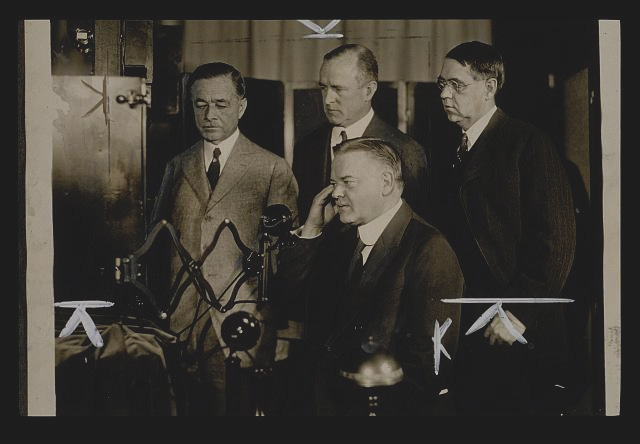
Today marks a watershed moment in the history of communication. In a demonstration that felt ripped from the pages of science fiction, engineers at AT&T’s Bell Telephone Laboratories successfully transmitted a moving image over 200 miles, from Washington, D.C., to a captivated audience in New York City.
The face on the screen was none other than Secretary of Commerce Herbert Hoover, who spoke into a device in the capital while his likeness—a small, flickering but recognizable image—appeared almost instantaneously before a crowd of journalists and scientists.
The experimental ‘television,’ as it is being called, not only carried Mr. Hoover’s image but also his voice, synchronized perfectly. Dr. Herbert E. Ives and his team have ushered in an era many thought was decades away.
While the technology is in its infancy, the implications are staggering: one day we may watch news events as they unfold and see the faces of our leaders from our very own living rooms. The world just became a much smaller place.
Source: The New York Times, ‘FAR-OFF SPEAKERS SEEN AS WELL AS HEARD HERE IN A TEST OF TELEVISION,’ April 8, 1927 ( a day after the event)
Why It Mattered
This event was the first public demonstration of long-distance television, proving the concept’s viability and marking the birth of a medium that would dominate communication, politics, and culture for the rest of the century.
Then vs Now
While this first broadcast was a low-resolution marvel for a select few, today we stream high-definition video to billions of personal devices globally, a direct and exponential evolution of this initial experiment.
🎂 Born On This Day
Babatunde Olatunji — a Nigerian-American drummer, educator, and social activist who became a major force in introducing African music to the West.